
03_Kometote Rice Gelato × Yoshida Farm (Miyazu city)
FOCUS
Introducing producers from Tango
Miyazu City
─
03_Kometote Rice Gelato × Yoshida Farm
Experiment with soil, weave materials.
Yoshida Farm's rice × Kometote's editing skills.
It all began with an encounter at the Kyoto Prefectural Tango Local History Museum (Furusato Museum Tango) .
A story about rice farming and rice gelato.
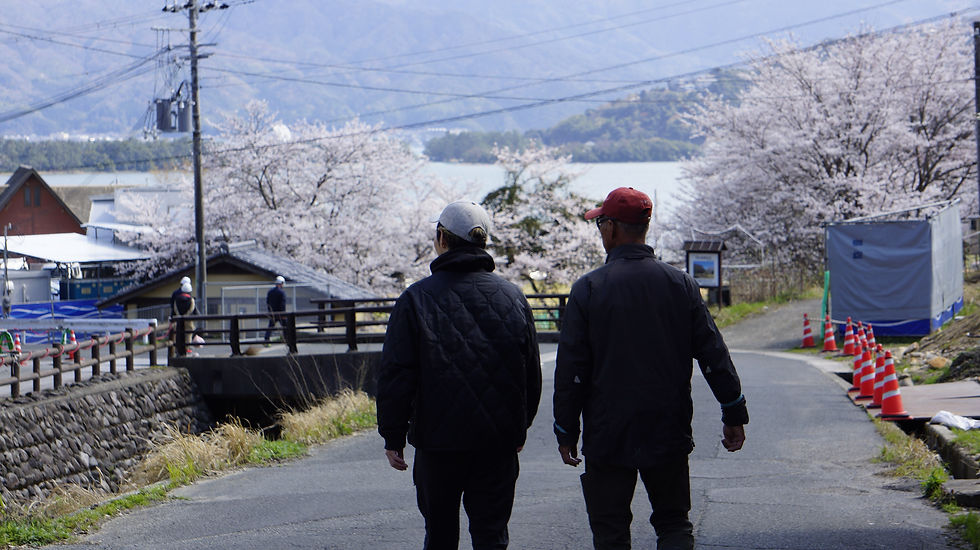
Enticed by the warm spring weather, on a day when the cherry blossoms were in full bloom,
This article discusses the "experiments" of Mr. Yoshida of Yoshida Farm, who communicates with microorganisms in the soil, and the craftsmanship of Ms. Hashida of Cometote, who "edits" ingredients using her 20 years of experience as a chef.
I had the opportunity to interview them.

From Fuchu, a town steeped in history, comes the taste of the future.
The location we visited for the interview was the Fuchu district of Miyazu City.
The Fuchu area is located at the base of Amanohashidate, one of Japan's three most scenic spots.
This was once the location of the provincial capital of Tango Province.
The region where they are based is deeply rooted in history and culture.

The two began to meet near Mr. Yoshida's fields.
The renovation of the "Furusato Museum Tango" was the catalyst.
The museum is currently undergoing renovations.
The renovation is scheduled for late March 2027 .
As a base for exploring the history and culture of Tango and for sightseeing,
Connecting diverse people and cultures in the region,
Based on the concept of a "hub museum" that fosters interaction and creativity,
Plans are underway to include a café within the complex.
"At the café inside the building, we wanted to offer something special that is unique to this area," said Yoshida, who deeply understands the charm of this region. Through connecting with producers active in the same Fuchu area, a connection was also made with Hashida of Cometote.
Giving shape to the "taken-for-granted" values found
in the local community.
The origin of Ms. Hashida's decision to launch "Kometote" was,
It all started with the question, "What can I do in my hometown of Tango?"
Mr. Hashida has grown up in this area, where eating "Special A-rank" rice has been the norm for a long time.
As the world re-evaluated the importance of food after the COVID-19 pandemic, there was a growing interest in dishes centered on plant-based ingredients. This led to the idea of "using local rice to create a new plant-based sweet," which was the first step in the creation of rice gelato.
Kometote has been using pesticide-free "Koshihikari" rice from Yoshida Farm since last year.
What captivated me the moment I saw it was the beauty of the rice grains.
The glossy appearance of the rice and the powerful umami flavor that spreads with every bite
For Mr. Hashida, who is particular about the ingredients he uses as a chef, this was apparently the biggest deciding factor.
"Anyway, the rice was beautiful."
The paths of these two individuals brought them together, leading to this collaboration.
Three rice paddies located at the uppermost reaches of "Yoshida Farm,"
which is close to the mountains.
This space was set up by Mr. Yoshida specifically for Kometote.
All our produce is grown without pesticides, but this is a special plot chosen for its access to even purer water.
Hashida's intuition was, "Because it was beautiful rice."
Yoshida responded by offering "the best spot."
I could feel mutual respect and trust.
Yoshida: Soil is a laboratory where life circulates.
"Communicating with the 'fungi' in the soil" to explore the essence of crops.
Mr. Yoshida, who grows rice and vegetables in the Fuchu area, constantly experiments and researches his soil preparation methods.
"Don't jump to conclusions from the start. You won't know until you fail," he said, his gaze fixed on the audience.
It was directed towards the invisible world beneath the soil.
Here are some of the practices that you are currently focusing on.
1. The power of "green manure": turning living organisms into fertilizer.
Currently, what Mr. Yoshida is focusing on in his soil preparation is "green manure."
Hairy vetch ( Vicia cracca ), a vine that grows wild around fields and farms,
When incorporated into the soil as green manure, it generates organic acids, which are said to improve the soil environment and promote the growth of subsequent crops.
The main reason why Mr. Yoshida is so particular about green manure is,
Apparently, it's because he feels the "deliciousness" of the rice he grows himself more than anyone else.
2. Living soil where microorganisms thrive
By adding rice bran to the soil, an environment is created where various microorganisms such as lactic acid bacteria and yeast can easily thrive, promoting decomposition and attracting earthworms. As the earthworms pass through, the soil is also softened and tilled. This state, where fermentation is well underway while still leaving some undecomposed organic matter, and where a large number of various microorganisms (filamentous fungi, actinomycetes, bacteria, etc.) are present in the compost, is called intermediate-matured compost, and Mr. Yoshida is currently using this farming method for his cultivation.
As you share various trial-and-error experiences,
The most impressive thing was the idea of "just trying it out."
I learn many farming methods and "experiment" with some of them every year.
If the experiment goes well, we'll try crossbreeding them further.
I make a lot of mistakes when I experiment, but I keep going because "you don't know until you fail."
Don't jump to conclusions from the start; constantly experiment and research.
Yoshida's craftsmanship, based on the principle that "it would be disrespectful to ignore the inherent properties of the crops,"
It is truly the science of the laws of nature.
It seemed to be bringing out the maximum vitality of the crops.

Hashida: "Editing" the materials and elevating them into a product.
The optimal solution for local production and consumption, derived from 20 years of experience.
A chef masters how to bring out the best in ingredients, and possesses not only the skill to arrange ingredients,
It is said that science, intelligence, and a good sense of aesthetics are required.
This is where Hashida's editing skills as a chef are most evident.
Rice milk is the base for gelato.
Inspired by delicious rice milk from overseas, I started experimenting on my own.
We struggled to adjust to the differences in stickiness depending on the type of rice, but we kept working towards achieving a taste we were satisfied with.
After many years of experience, I finally arrived at this conclusion.
"Combining materials from that region results in the most complete and refined product."
The idea of minimal local production and consumption
This led to our current products, which utilize materials from Tango.
This rice, created by Mr. Yoshida as a result of his "experiments," boasts a deep, rich flavor.
By combining this with the abundant seasonal ingredients
from Tango carefully selected by Ms. Hashida,
We are re-weaving it into a truly unique product.
Furthermore, as we continued product development focusing on plant-based ingredients,
We hadn't initially anticipated vegans and vegetarians.
It seems that the product is gaining recognition as a product that meets customer needs.
As a result of Mr. Hashida's continued pursuit of the terroir of Tango,
At the heart of being able to spread new values there was,
His undeniable editing skills as a chef are evident throughout.
・
Producer Yoshida repeatedly conducts "experiments" to determine the essence of the soil and crops.
Hashida then "edits" those ingredients into products through the filter of a chef.
Rice and rice gelato
The gelato created from the session between the two of you is
This dish truly embodies the scientific principles of Tango's climate and culture, resulting in an intelligent and profound creation.
We have received their sincere feelings and, through sales at our store,
I would like to participate in this creative cycle.
Editor's note:
We were able to give Tango rice a new value.
They know exactly how to "subtract" from the materials and how to make the most of them.
This interview made me realize that it was only possible because of Mr. Hashida's career as a chef at Komete.
"Combining local ingredients is the best approach."
True to its word, the rice gelato, infused with the unique character of Tango,
It has a gentle, yet deep flavor.
Hashida-san, as a means of promoting Tango rice,
They are also considering developing and expanding the rice milk itself as a product.
I look forward to your future endeavors.
Interview date: April 2, 2026
Interview location: Fuchu area, Miyazu City, Kyoto Prefecture (Kometote Rice Gelato, Yoshida Farm)
Information:
Kometote Rice Gelato
242-1 Komatsu, Miyazu City, Kyoto Prefecture
Yoshida Farm Co., Ltd.
843 Kokubu, Miyazu City, Kyoto Prefecture


